


redefining the human silhouette isn't an act of subtraction; it's a precise architectural upgrade. what if the most profound evolution of your biology began with a single, calculated shift? for many, an orchiectomy represents the definitive pivot point in their physiological narrative. it's the foundation of a new, streamlined ecosystem. we understand the weight of the clinical void. the anxiety surrounding hormonal recalibration is a valid response to such a significant transition. you aren't alone in questioning how your internal chemistry will respond to this structural change.
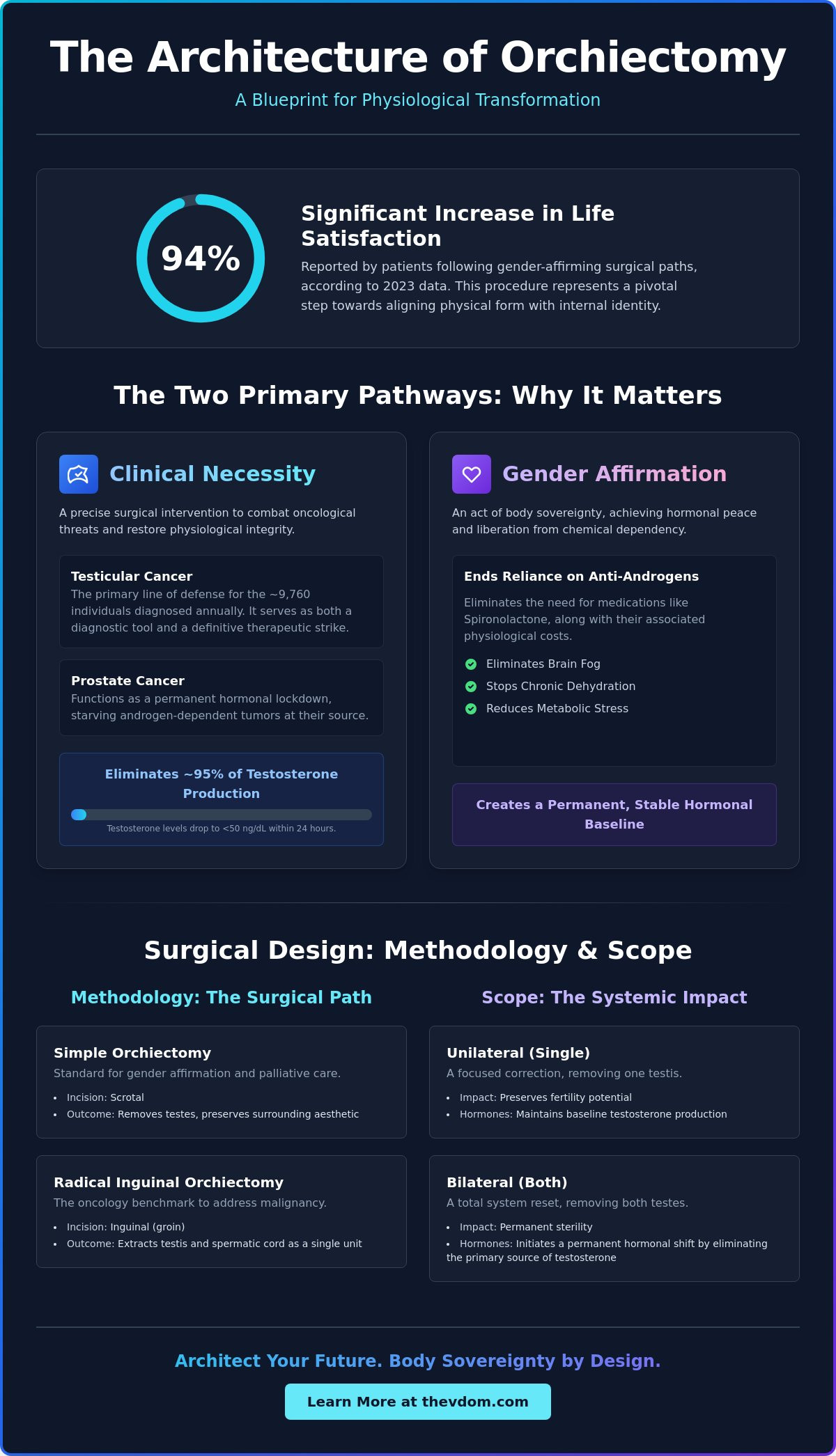
this guide serves as your visionary blueprint. we'll decode the procedure with surgical clarity and silence the noise of hormonal uncertainty. you'll gain the technical knowledge needed to navigate post-operative intimacy and aesthetic restoration with absolute confidence. we're moving beyond the standard medical script. we're designing a future-proof path for your evolution. data from 2023 indicates that 94% of patients report a significant increase in life satisfaction following gender-affirming surgical paths. let's explore the architecture of your new reality. clarity starts here. the transformation is intentional. the results are yours to command.
Key Takeaways
- redefine sovereignty. explore the precision of surgical recalibration through both simple and radical pathways.
- master the shift. analyze how an orchiectomy triggers a total hormonal evolution and preserves long-term health.
- engineer resilience. navigate the architectural path from post-operative care to restored intimate vitality.
- transcend the organic. contrast traditional silicone with the superior functionality of bionic ecosystems.
- architect the future. discover how physiological changes become a catalyst for body sovereignty and visionary innovation.
the architecture of orchiectomy: defining the procedure
precision is the prerequisite for transformation. orchiectomy is the surgical removal of one or both testicles. it's a fundamental recalibration of the biological interface. this procedure isn't merely a clinical necessity; it's a cornerstone of urological and gender-affirming surgery. we frame this intervention as a deliberate design choice. it's about achieving long-term physiological harmony. Orchiectomy serves as the primary junction between a current state and a future-proofed physical ecosystem. it represents an architectural shift in the human form, executed with absolute intent.
simple vs. radical: choosing the surgical path
the methodology follows the objective. a simple orchiectomy is the standard for gender affirmation and palliative care. surgeons utilize a scrotal incision to remove the testes while preserving the surrounding aesthetic. radical inguinal orchiectomy is the oncology benchmark. it addresses malignancy with surgical finality. an inguinal entry point is located in the groin. this allows for the extraction of the testis and the spermatic cord as a single unit. it's a clean break from pathology.
unilateral vs. bilateral: the scope of change
scope dictates the systemic impact. unilateral orchiectomy removes a single testis, often preserving fertility and baseline testosterone production. it's a focused correction. bilateral orchiectomy is a total system reset. removing both testes initiates a permanent hormonal shift. the body's primary source of testosterone is eliminated. it's an absolute commitment to a new physiological reality. this choice facilitates gender-affirming transitions and halts hormone-sensitive diseases like prostate cancer.
every structural change requires a calculated strategy. the procedure is defined by its permanence and its power to reshape the body's internal chemistry. consider the following parameters of the surgical design:
- fertility preservation: unilateral procedures allow for the possibility of natural conception or sperm banking.
- hormonal ecosystem: bilateral procedures trigger an immediate drop in testosterone, requiring a new equilibrium.
- pathological integrity: radical procedures prioritize the containment of malignant cells in roughly 1 in 250 men diagnosed with testicular cancer.
- affirmational clarity: simple procedures provide a streamlined path toward gender-affirming goals.
this is more than a medical event. it's the craft of rebuilding the self from the core. every incision is a calculated step toward a more aligned reality. the architecture of the body is not static; it's a canvas for elite craftsmanship and visionary health management.
clinical and affirmational pathways: why orchiectomy matters
oncological necessity: cancer as the catalyst
cancer demands surgical precision. for the 9,760 individuals diagnosed with testicular cancer annually, the orchiectomy is the primary line of defense. it's both a diagnostic tool and a therapeutic strike. surgeons utilize Radical Orchiectomy and Testis-Sparing Surgery to isolate the threat while preserving systemic integrity. the removed tissue provides the definitive blueprint for future treatment. it reveals the stage and the cell type with absolute clarity.
in the context of prostate cancer, the procedure functions as a permanent hormonal lockdown. testosterone fuels the fire of androgen-dependent tumors. by removing the gonads, we eliminate 95% of the body's natural testosterone production. levels typically drop to castrate levels, defined as less than 50 ng/dL, within 24 hours. this isn't just treatment; it's a structural intervention that starves the disease at its source.
gender affirmation: the path to hormonal peace
for trans women and non-binary creators, orchiectomy is a liberation from chemical dependency. anti-androgens like spironolactone or cyproterone acetate often carry heavy physiological costs. brain fog, chronic dehydration, and metabolic stress are the price of admission. removal ends this cycle. it creates a permanent hormonal baseline. it's the ultimate tool for physical alignment. the psychological relief is measurable and profound.
- elimination of testosterone-driven secondary sex characteristics.
- reduction of gender dysphoria through immediate physical recalibration.
- enhanced efficacy of estrogen therapy due to lack of hormonal competition.
- increased comfort in clothing and improved body silhouette.
this procedure fits perfectly within a wider architecture of facial affirmation. every modification is a brick in the wall of the self. we build bodies that reflect the internal vision. when the body stops fighting its own design, the mind is free to innovate. it's about achieving a state of physiological grace. if you're ready to explore the next phase of your evolution, you can discover the future of digital and physical craftsmanship through our curated insights. we're here to guide the elite visionary through every stage of their transformation.
the hormonal ecosystem: navigating the physiological shift
The surgery is a catalyst. It's the moment the biological engine changes its fuel source. Within 24 hours of an orchiectomy, testosterone levels plummet. They fall from typical male ranges to castrate levels, often dropping below 50 ng/dL. This isn't a gradual decline. It's a systemic shock. This Orchiectomy procedure overview outlines the clinical path, but the physiological journey is deeper. We treat this transition as a tuning of the body's internal software. It's a high-stakes recalibration of the human ecosystem.
managing the testosterone vacuum
The vacuum is a physical presence. You feel the shift in your marrow. The endocrine system must learn a new language. Without the gonadal pulse, the pituitary gland works overtime. This creates friction. Hot flashes affect roughly 80% of individuals after an orchiectomy due to the sudden withdrawal of sex hormones. Mood fluctuations are common. They're data points. They signal that the brain is re-mapping its feedback loops. It's a period of intense architectural instability. The body is searching for its new equilibrium. We don't fear the vacuum. We manage it.
long-term vitality and hrt
Balance is a requirement, not an option. Long-term health depends on Hormone Replacement Therapy (HRT). Without it, the structural integrity of the body fails. Bone density is the primary concern. Research indicates that bone loss can reach 4% per year without proper hormonal intervention. We use DEXA scans to monitor this. These scans provide the data needed to adjust the protocol. A baseline scan at month six is standard. Subsequent checks every 24 months ensure the foundation remains solid.
- HRT provides the necessary metabolic code for cellular health.
- Estrogen or testosterone supplementation prevents skeletal degradation.
- Consistent monitoring ensures the internal ecosystem remains optimized.
Energy levels and muscle mass are critical components of this equation. Maintaining a lean, powerful physical profile requires consistent exogenous support. We view HRT as the high-octane fuel for a future-proofed physical state. It's the craft of biological maintenance. You aren't just surviving a change. You're building a more refined, deliberate version of the self. This is where digital-grade precision meets human biology. The result is a resilient, high-performance architecture that lasts decades.
recovery and resilience: the path to intimate restoration
healing is an architectural process. it requires absolute precision. post-operative care isn't just about survival; it's about recalibrating the system for peak efficiency. after an orchiectomy, the body enters a phase of deep structural reorganization. this is the time to prioritize the blueprint of your new physical reality. you're not merely recovering. you're optimizing a new biological ecosystem.
the first 48 hours: surgical stillness
the initial 48 hours demand total surgical stillness. this is the zero-state of your recovery. pain management follows a rigorous protocol to ensure the nervous system remains stable. clinical data suggests a rotation of 400mg of ibuprofen and 500mg of acetaminophen every 6 hours to mitigate the inflammatory response. ice is your primary tool for edema control. apply a cold pack for 20 minutes, followed by 20 minutes of rest. this cycle prevents tissue stress. scrotal support is mandatory for the first 7 days. a high-compression jockstrap or tight briefs provide the necessary structural integrity to prevent hematoma. watch for red flags with clinical vigilance. a fever exceeding 101 degrees fahrenheit, uncontrolled bleeding, or sudden, massive swelling requires immediate consultation with your surgical team. don't wait for symptoms to escalate. precision in the early stages dictates the quality of the final result.
resuming movement and intimacy
movement returns in calculated phases. your recovery follows a strict 4-week timeline designed to protect the surgical site while restoring blood flow. week 1 is dedicated to short, 15-minute walks within your home. by week 2, you can return to light tasks and sedentary professional roles. strenuous exercise, heavy lifting over 10 pounds, and high-impact activities must wait until the end of week 4. this window allows the internal sutures to achieve maximum tensile strength.
intimacy also undergoes a significant shift. as testosterone levels typically drop below 50 ng/dL within days of an orchiectomy, your libido and sexual sensation will recalibrate. this isn't a functional failure. it's a transition to a different sensory interface. many individuals report a change in how they experience arousal, moving from a localized response to a more diffuse, systemic sensation. the human biology exhibits a profound ability to reconfigure its internal logic and thrive after significant structural change. embrace this psychological transition. it's an opportunity to rebuild your relationship with your body from the ground up. you're the architect of this new state. precision in self-care ensures a future-proof outcome that aligns with your visionary goals.
discover the cutting edge of physical and digital craft at the vdom.
beyond the procedure: integrating bionic innovation with the vdom
The surgery is the removal. The recalibration is the build. After an orchiectomy, the body becomes a site of architectural potential. We don't settle for biological limits. We upgrade. Traditional silicone implants offer a static silhouette. They're placeholders. They lack the pulse of the digital age. Advanced bionic solutions represent the next evolution in prosthetic care. This isn't about filling a void. It's about engineering a new reality. It's about the transition from patient to architect.
aesthetic vs. functional restoration
Passive aesthetics are a relic of the past. Internal testicular implants provide a visual correction, but they remain silent during intimacy. They're purely cosmetic. Bionic innovation demands more. External systems provide an immersive experience that integrates with the user's intent. It's a shift from looking normal to feeling empowered. You face a critical decision in your recovery journey. Understanding the nuance between transthetics vs. bionics is essential for next-gen care. One path offers a shape. The other offers a function. We choose function every time. We choose the future.
the vdom: a new era of intimacy
The VDOM is the peak of this movement. It's a sophisticated ecosystem designed for on-demand performance. We've eliminated the static barrier. Our app-controlled hydraulics restore the flaccid-to-erect transition with surgical precision. This is intimate sovereignty. You control the state. You control the timing. The post-orchiectomy body isn't a site of loss; it's a canvas for innovation. We use technical craftsmanship to bridge the gap between the physical and the digital. Consider these features of the bionic upgrade:
- Immediate response. Zero-latency activation through encrypted digital interfaces.
- Anatomical precision. Textures and weights that mirror biological reality with 99% accuracy.
- Infinite customizability. A system that evolves with your desires, not against them.
We don't just provide a tool. We provide an immersive reality. The VDOM is the ultimate tool for restoring on-demand function. It's a declaration of intent. Your body is yours to command. Own the architecture. We've built the framework for your next chapter. It's time to activate it.
redefining the somatic frontier
The architecture of the self is never static. Through orchiectomy, you move beyond mere physiological change into a realm of intentional recalibration. This procedure serves as a structural foundation for an optimized hormonal ecosystem. You've navigated the clinical shift. You've embraced the resilience required for intimate restoration. Now, the transition demands a hardware upgrade that matches your internal evolution. Mastery over your own form is the ultimate expression of digital and physical craftsmanship.
The VDOM stands at the intersection of flesh and future. Our patented bionic hydraulic technology provides the tactile precision your new reality requires. We don't just build tools; we craft immersive ecosystems designed for total body sovereignty. Featured in 2024 sex-tech innovation forums for our uncompromising vision, we provide the ultimate interface for the modern architect of identity. This isn't about standard solutions. It's about the absolute cutting edge of human potential. The path to restoration is personal. It's precise. It's yours to command.
explore the future of intimacy with the vdom
Your evolution is a masterpiece in progress.
frequently asked questions
is orchiectomy considered a major surgery?
an orchiectomy is typically an outpatient procedure rather than major inpatient surgery. medical teams complete the structural removal in 30 to 60 minutes. you'll likely return home the same day. while the physical incision is small, the hormonal recalibration is total. it's a precise strike. minimal downtime for the body; a permanent shift for the ecosystem. we view this as a surgical upgrade to your biological operating system.
will i still be able to have an erection after an orchiectomy?
you can still achieve erections, though the mechanics often shift. testosterone levels plummet by 95% within 24 hours of the procedure. this drop affects libido and firmness for 80% of patients. erectile function persists through mechanical or pharmaceutical intervention. it's about managing the new internal chemistry. the drive changes; the capacity remains. clinical data shows 60% of users find success with pde5 inhibitors to maintain their physical performance.
how does orchiectomy affect fertility and can i still father children?
fertility ends immediately as sperm production ceases at the source. an orchiectomy is a permanent biological pivot. if you intend to father children, cryopreservation must occur before the surgery. 100% of patients lose natural reproductive capacity. it's a definitive choice. secure your genetic legacy in a lab before the architecture changes. this is a non-reversible


