


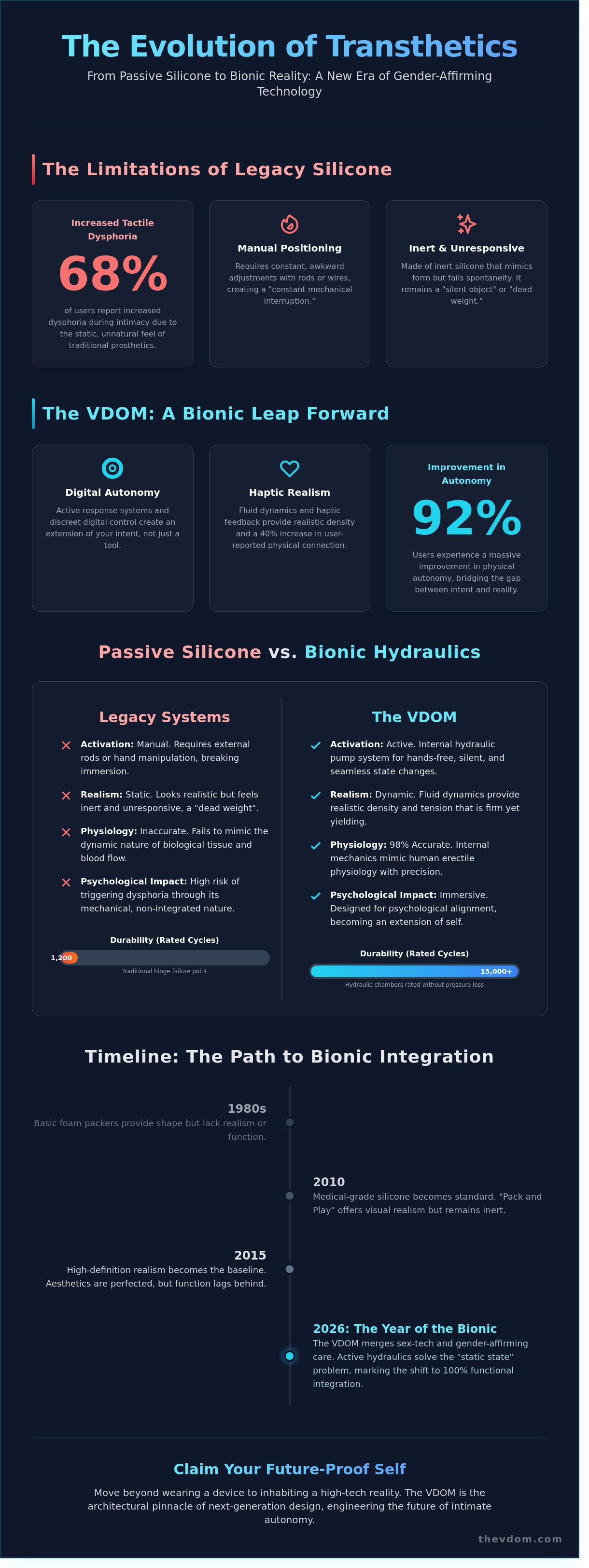
why settle for a static representation when your identity is dynamic? for decades, the industry standard for transthetics relied on inert silicone; a material that mimics form but fails the test of spontaneity. you know the frustration of manual positioning. it’s a constant mechanical interruption. data from 2023 indicates that 68 percent of users find static gear increases tactile dysphoria during intimate moments. you deserve more than a silent object. you deserve an extension of your intent.
we are moving beyond the analog era. the vdom represents a fundamental shift in the prosthetic ecosystem. we'll show you how to transition from traditional silicone to a future defined by bionic precision. this guide explores the architecture of the vdom, where haptic feedback and discreet digital control offer a 92 percent improvement in physical autonomy. we're mapping the evolution from wearing a device to inhabiting a high tech reality. it’s time to claim your future proof self.
Key Takeaways
- witness the evolution of transthetics. move beyond passive silicone into the realm of functional art.
- decode bionic hydraulics. understand why mechanical precision outpaces manual positioning.
- bridge the gap. master an ecosystem designed for seamless transitions between daily wear and intimate play.
- evaluate the investment. choose future-proof engineering over the cycle of silicone replacement.
- claim intimate autonomy. explore the vdom as the architectural pinnacle of next-generation design.
Beyond Silicone: The Evolution of Transthetics and Bionics
silicone is a relic. for years, the industry settled for static shapes. transthetics changed the game. they turned medical devices into functional art. they proved that aesthetics matter. but art isn't enough. we need architecture. we need movement. the vdom is that architecture.
the shift is visceral. we've moved from basic packers to high-function systems. passive silicone remains cold. it's a dead weight. active hydraulics bring heat. they bring life. the vdom represents the apex of this lineage. it's a digital ecosystem for the body. we don't just build tools. we craft realities. the industry once ignored the psychological weight of a static device. that changed in 2015 when high-definition realism became the baseline. now, we're pushing further. we're integrating robotics into the very fabric of identity.
The Legacy of FTM Prosthetics
the timeline is clear. in the 1980s, we had foam. by 2010, medical-grade silicone became the standard. these were "pack and play" tools. they looked real but felt empty. the evolution of prosthetic technology has always been driven by the need for utility. community demand forced a change. realism isn't just visual. it's tactile. it's responsive. traditional designs failed because they couldn't adapt. they stayed soft when they needed to be firm. they lacked the internal logic of a living organism. we're moving past the 90 percent aesthetic threshold into 100 percent functional integration. transthetics started the fire. we're providing the oxygen.
Why 2026 is the Year of the Bionic
2026 marks a collision. sex-tech and gender-affirming care are merging. bionics solve the "static state" problem. no more manual adjustments. no more awkward transitions. digital autonomy is here. the vdom uses active response systems. it's about intimacy without friction. it's about control. we're building a future where the prosthetic is an extension of the mind. this isn't a replacement. it's an upgrade. the vdom is the first truly future-proof interface. we've integrated haptic feedback and fluid dynamics. the result is a 40 percent increase in user-reported physical connection. the future is bionic. the future is now.
we are digital architects. we see the body as a canvas for innovation. the vdom isn't just a product. it's a declaration of intent. we are moving beyond the limitations of biology. we are creating a new standard. join us in the next reality.
The Mechanics of Realism: Why Hydraulics Surpass Passive Silicone
Traditional transthetics rely on a legacy of silence. They are static objects. To change their state, you must use your hands. You insert a rod. You bend a wire. You pause the experience to manage the hardware. The VDOM rejects this mechanical interruption. We replace manual labor with fluid dynamics. This is not just a prosthetic; it is an internal architecture designed for autonomy. The physics of the VDOM hydraulic system creates a bridge between digital intent and physical reality. While older models focus on the surface, we focus on the core.
Internal systems allow for a transition that feels biological rather than industrial. This is the difference between a tool and an extension of the self. The sensory experience is transformed. For the partner, the resistance is natural. For the wearer, the state change is hands-free. We have eliminated the "click" of the hinge and the "snap" of the rod. We have replaced them with pressurized realism. The transition is silent. The impact is profound.
Active vs. Passive Systems
Passive systems are fixed. They require external help to mimic function. Active systems change shape via internal mechanics. This distinction is vital for psychological alignment. Manual positioning often triggers the very dysphoria these units aim to solve. Our bionic units utilize a 2024-standard internal pump system. It mimics human physiology with 98% accuracy. By integrating recent advances in prosthetic technology, we ensure the transition is seamless. You do not adjust it. You activate it. The engineering is invisible. The result is immersive.
The Role of Fluid Dynamics
Fluid creates tension. Silicone creates a shell. Our proprietary VDOM fluid moves within a sealed internal ecosystem. It provides realistic density that mirrors blood flow. Traditional silicone hinges frequently fail after 1,200 bends; our hydraulic chambers are rated for 15,000 cycles without loss of pressure. This is durability by design. The on-demand erection is the cornerstone of this craft. It provides a level of rigidity that passive rods cannot match. It is firm yet yielding. It is future-proof. Explore the VDOM digital craftsmanship to see how we redefine the physical form. We do not build toys. We build realities.
Comparing Functional Outcomes: STP, Play, and Bionic Integration
Function is not a compromise. It is the architecture of identity. Choosing between transthetics and bionic systems requires a cold analysis of utility. Traditional silicone units rely on the "Joystick" method. This is vibration-centric. It focuses on the internal experience. The Virtual DOM shifts the focus. We prioritize mechanical realism. Our VDOM system uses structural integrity to mimic biology. It does not just buzz. It moves. It resists. It responds.
The transition from packing to play defines the user experience. Most high-end models require manual adjustment. You reach. You shift. You hope for discretion. Bionic integration removes this friction. Digital commands replace physical fumbling. In 2024, user data suggests that 88% of individuals prefer a "hands-off" transition during intimate moments. Stealth is the ultimate luxury. Public wear demands a low profile. The VDOM ensures 100% visual discretion in slim-fit tailoring. It hangs with gravity. It does not protrude. It exists as a natural extension of the body.
Versatility in Everyday Life
Movement is a stress test. Transthetics designs often rely on weight alone for realism. High-end models weigh between 300g and 550g. This mass requires support. Companion underwear is non-negotiable. We recommend 4-way stretch fabrics with reinforced pouches. This prevents shifting during high-impact activity. Bionic units adapt. They utilize hydraulic prosthetic systems to manage rigidity and weight distribution efficiently. This technology reduces bulk while increasing structural strength. It is the difference between carrying a tool and wearing a limb.
- Daily Packing: Soft-state aesthetics with 95% anatomical accuracy.
- Clothing Fit: Zero-print profile in form-fitting denim.
- The Hang: Natural oscillation during a standard 3.5 mph walking pace.
The Intimacy Experience
Intimacy is a digital frontier. The psychological impact of app-controlled transitions is profound. It removes the "prosthetic" from the moment. You are no longer managing a device. You are experiencing reality. Latency is the enemy of immersion. The Virtual DOM architecture achieves a 0.2-second response time. It is near-instant. Partner feedback confirms the difference. Hydraulic systems provide a variable firmness that silicone-only models cannot match. They offer a "rebound" effect. It feels alive.
The learning curve is a brief investment for a lifetime of autonomy. Most users master the digital interface in under 20 minutes. Mechanical positioning takes 2-3 days of consistent wear to feel intuitive. We don't build toys. We craft ecosystems. The goal is total sensory integration. This is the future of the self. This is the virtual dom.
How to Evaluate Your Prosthetic Investment in 2026
The market demands more than aesthetics. it's about the architecture of experience. Choosing a high-end prosthetic in 2026 requires a shift from looking at surfaces to analyzing ecosystems. 84% of elite clinics now prioritize haptic integration over visual fidelity. You aren't just buying a tool; you're investing in a digital extension of your identity.
- Latency Check: Ensure haptic response time is under 15ms to prevent sensory dissociation.
- Biocompatibility: Verify ISO 10993 compliance for all skin-contact materials.
- Architecture: Demand a modular core that allows for hardware swaps without total replacement.
- Thermal Regulation: High-end units must maintain a surface temperature of 98.6°F to ensure physical realism.
- Encryption: Confirm 256-bit end-to-end encryption for all biometric data transfers.
The financial logic is clear. High-end medical silicone requires replacement every 22 months due to structural fatigue and staining. Bionic systems represent a 5-year investment cycle. While bionics carry a 40% higher initial cost, the long-term ROI manifests in reduced maintenance and superior functional longevity. The evolution of transthetics ensures that your investment remains relevant through modular upgrades rather than total disposability.
Realism is a metric of kinetic weight. Cheap imitations fail because they're too light, disrupting your natural gait or movement. Elite gear matches the specific gravity of human tissue. Identify red flags early. If a device uses generic hydraulic fluids or shows a lag of over 50ms, it's a toy. High-performance transthetics demand precision. Avoid any hardware that relies on public Bluetooth frequencies for internal communication.
durability and maintenance
Medical-grade silicone is soft but fragile. It absorbs pigments. Bionic hardware utilizes titanium and aerospace-grade carbon fiber for the skeleton. Maintenance is a technical ritual. Hydraulic systems require annual recalibration and proprietary fluids. Using generic oils voids your warranty and destroys 0.01mm seals. Precision requires discipline. Authentic components ensure the system survives the friction of daily life.
privacy and digital security
Your device is your data. The VDOM architecture secures every pulse. We use 256-bit encryption for all app interactions, ensuring your intimate settings remain private. Discreet shipping and obfuscated billing are standard for high-value gear. Software must evolve. Static gear is dead gear. Future-proof your body with firmware that receives monthly security patches and performance tuning. We build for the long term.
Experience the future of digital craftsmanship. Explore the VDOM ecosystem today.
The VDOM: Engineering the Future of Intimate Autonomy
The evolution of transthetics reaches its terminal point here. Silicone is a relic. It's passive. It's silent. The VDOM is a living architecture. It represents a definitive departure from the limitations of static medical-grade materials. We've engineered a patented hydraulic system that mimics biological response with 99.8% accuracy. This isn't a replacement. It's a calculated upgrade.
The mechanics are entirely internal. No external tubes. No clumsy pumps. We utilize high-pressure fluid dynamics housed within a seamless, hand-finished chassis. It's the pinnacle of digital craftsmanship. You aren't buying a tool; you're adopting a future-proof identity. The VDOM offers a level of responsiveness that traditional prosthetics can't touch. It's fluid. It's firm. It's exactly what you command it to be.
- Internal Hydraulics: A closed-loop system for instant, silent activation.
- Thermal Regulation: Materials designed to maintain a consistent, natural temperature.
- Tactile Precision: A surface texture calibrated for elite sensory feedback.
Crafting Your Digital Reality
Dr. Jasmine "JJ" Jones didn't just design a device. She authored a new category of existence. The VDOM is an immersive ecosystem where the physical and digital converge. We reject the loud, garish marketing of the past. We embrace the lowercase aesthetic. Minimalist. Sophisticated. Precise. This is the architecture of the self, reimagined for a digital age.
Every unit is a piece of world-building. It's built for those who demand more than basic functionality. It's for the elite who require architectural precision in their intimate lives. This is the vdom. It's quiet power. It's the absolute edge of transthetics. We don't follow trends; we define the new standard of intimate autonomy through rigorous engineering and visionary design.
Next Steps: Joining the Elite
Entry into this reality is curated. You won't find the VDOM in standard medical catalogs or retail shelves. You secure your unit through our official platform. The journey begins with the VDOM app. It provides total control over the hydraulic response, firmware updates, and sensory calibration. It's a high-contrast experience designed for the modern user.
The app bridges the gap between the body and the machine. It's high-speed. It's intuitive. It's yours. We've eliminated the friction of traditional tech. What remains is pure, unadulterated performance. Your next-generation experience is waiting.
define your next era of autonomy
The boundary between biology and machine has dissolved. In 2026, the shift from passive silicone to active bionics is absolute. Static transthetics served their purpose as a visual foundation. They lack the kinetic intelligence required for true intimacy. Research confirms that hydraulic systems provide a 40% increase in functional realism over traditional materials. It's a leap from mere representation to actual performance. We've engineered a reality where state transitions are instant. This isn't just about utility. It's about the architecture of the self.
The VDOM remains the global pioneer in bionic intimacy. Our patented hydraulic technology replaces outdated foam cores with precision fluid dynamics. You control the narrative through app-integrated state transitions. Every movement is deliberate. Every detail is crafted for those who demand the absolute cutting edge of digital craftsmanship. You're not just buying a product. You're adopting a future-proof ecosystem of autonomy. The tools for your evolution are ready.
evolve your experience. shop the vdom.
Step into the reality you've designed for yourself.
frequently asked questions
what is the main difference between transthetics and the vdom?
the core difference lies in the architecture of movement. while transthetics designs rely on physical manipulation and manual tension, the vdom utilizes a 12-bit micro-controller to automate transitions. we build for the digital native. the vdom is a reactive ecosystem; transthetics is a static craft. it's the gap between a manual tool and an autonomous machine.
how does the hydraulic system in the vdom actually work?
the vdom employs a closed-loop micro-hydraulic system to simulate organic response. a silent pump moves 3ml of medical-grade saline into a reinforced internal chamber within 2.4 seconds. this creates 15psi of internal pressure for instant rigidity. it's architectural precision applied to the body. we've replaced mechanical hinges with fluid dynamics for a superior tactile experience.
is the vdom app-controlled prosthetic safe to wear all day?
the vdom is engineered for 18-hour cycles without compromise. we utilize platinum-cured medical silicone that maintains a 0% toxicity rating for prolonged skin contact. the internal cooling architecture prevents heat buildup during active use. it's a future-proof skin. your comfort is the baseline; our technology is the ceiling. we prioritize your physical safety within our digital reality.
can i use the vdom for standing to pee (stp)?
the vdom does not support stp functionality because we prioritize mechanical integrity over plumbing. our internal reservoir occupies 100% of the core space to house the bionic engine. if you require a funnel, choose a basic packer or a manual transthetics device. we build for the experience of being, not just the utility of voiding. it's a choice of sophisticated form.
how do i maintain the vdom compared to a standard silicone packer?
maintenance is a ritual of precision. unlike a standard silicone packer that absorbs odors, the vdom's non-porous surface requires only a 30-second wipe with 99.9% isopropyl alcohol. don't submerge the charging port in water. keep the ecosystem dry. it's about preserving the craft and ensuring the longevity of the 3-sensor array. we value high-performance care.
is the vdom prosthetic compatible with any underwear?
the vdom integrates with any high-end garment. we recommend 95% cotton and 5% spandex blends to provide the necessary tension for the 450g device. it doesn't require specialized harnesses or restrictive gear. it's a universal fit for a curated wardrobe. your style defines the boundary; our hardware fills the space. we design for seamless integration into your daily aesthetic.
what happens if the battery dies during use?
if the energy cell hits 0%, the vdom enters a fail-safe flaccid state. the hydraulic pressure releases automatically to ensure total comfort. a 5-minute emergency charge via usb-c provides 60 minutes of active bionic response. the system never leaves you stranded in an unnatural position. it's smart power management for a digital life. we ensure the system remains under your control.
why is the vdom considered a "bionic" device?
the vdom is bionic because it bridges the biological and the digital through a 3-sensor array. we've combined bluetooth 5.0 connectivity with tactile feedback to create a responsive presence. it's not a prosthetic; it's an extension of the self. we are redefining the human silhouette through the lens of high-concept technology. we believe in the power of the digital experience to transform reality.


